
How to Know If Your Candidate Actually Knows Data Cloud
My favorite JD genre: "5+ years of Data Cloud experience required."
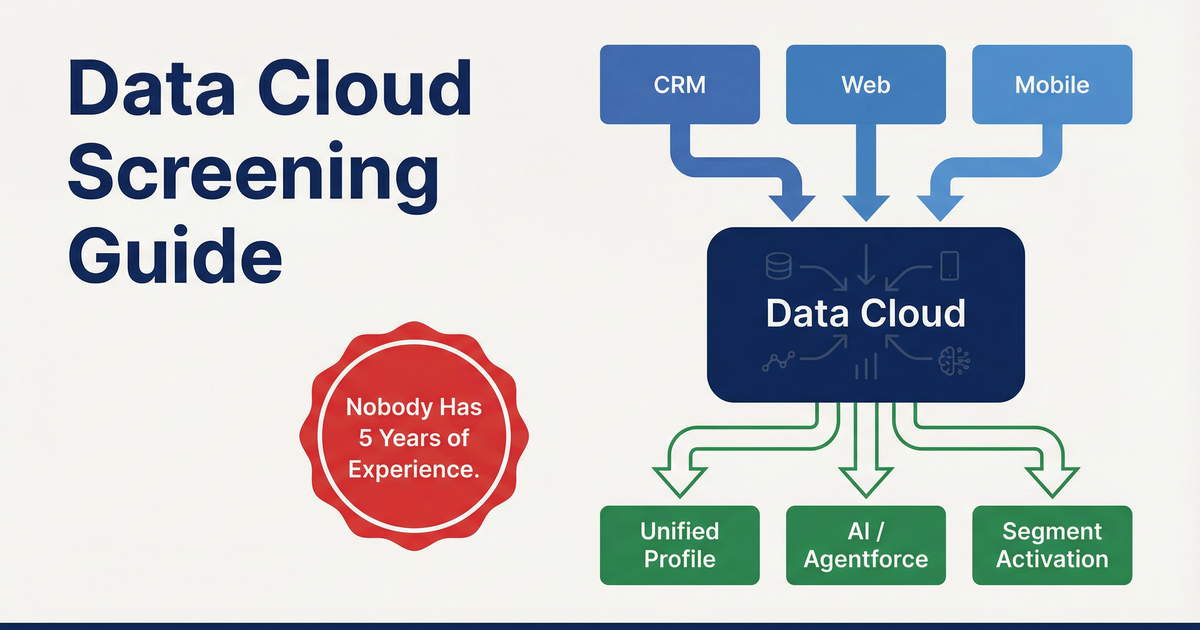
Data Cloud has been generally available since late 2022. Nobody on this planet has 5 years of experience with it. Your best candidate has 2 years. Your realistic candidate has 6 months of real implementation work and a stack of Trailhead badges.
Data Cloud is Salesforce's platform for unifying data from multiple sources (CRM, web, mobile, third-party systems) into a single customer profile. It powers AI features like Agentforce and Einstein by giving those tools access to data beyond what lives in standard Salesforce objects. It is the newest major product in the ecosystem, which means the talent market is thin and expectations need to be calibrated accordingly.
Core Components
Data Cloud has its own architecture, separate from standard Salesforce:
Data Stream: Ingestion pipeline from external sources. S3, Google Cloud Storage, API, or the Salesforce CRM connector. Batch or streaming.
Data Lake Object (DLO): Raw ingested data in the original source format. This is the staging area before mapping.
Data Model Object (DMO): Structured, mapped tables following Salesforce's Customer Data Model. Data flows from source to DLO to DMO. If a candidate cannot describe this flow, they have not configured a data stream.
Identity Resolution: Matches records across different sources to create unified customer profiles. Match rules, reconciliation rules, probabilistic vs. deterministic matching.
Calculated Insight: Computed metrics from unified data. Scoring models, aggregations, derived attributes.
Segment: Audience groups based on criteria from unified profiles. Activation-ready.
Activation Target: Where segment data goes: Marketing Cloud, Google Ads, Meta, custom webhooks.
Experience Tiers
Beginner: Connect Salesforce CRM data stream. Map fields to DMOs. Create basic segments. Build reports on Data Cloud objects.
Intermediate: Configure identity resolution with match and reconciliation rules. Design segment activation to Marketing Cloud. Create calculated insights. Map multi-source data to the Customer Data Model.
Advanced: Architect data model across 5+ source systems. Enterprise-scale identity resolution strategy. Connect Data Cloud to Agentforce for AI grounding. Data governance and consent management within Data Cloud. Real-time streaming pipelines.
Five Screening Questions
1. "What is identity resolution and why does it matter?" Strong: Explains matching records across systems. Describes match rules and probabilistic vs. deterministic approaches. Red flag: Confuses Data Cloud identity resolution with standard Salesforce duplicate management. Different systems solving different problems.
2. "How do data streams work? Give me a real example." Strong: Describes ingesting from S3, GCS, or API. Explains batch vs. streaming ingestion and when each is appropriate. Red flag: Has only completed Trailhead modules and has never connected an actual external data source.
3. "What are Data Model Objects vs. Salesforce objects?" Strong: DMOs follow the Customer Data Model. Can describe the DLO-to-DMO mapping relationship and why Data Cloud has its own data model. Red flag: Uses Salesforce object terminology interchangeably with Data Cloud terminology.
4. "How would you use segments and activation targets?" Strong: Describes audience segments from unified profiles activated to marketing channels or ad platforms. Red flag: Confuses Data Cloud segments with Marketing Cloud audience builder or Salesforce report filters.
5. "Have you worked with calculated insights or Data Cloud for AI?" Strong: Describes calculated insights for scoring or connecting Data Cloud to Agentforce features. Red flag: Claims extensive experience with zero production use cases. Given how new the product is, this should raise questions immediately.
How to Tell If Someone Is Lying
"What is the difference between a DLO and a DMO?" Real: DLOs hold raw data in source format. DMOs are structured, mapped to the Customer Data Model. Data flows source to DLO to DMO. Can explain why staging matters. Fabricated: Cannot distinguish between the two. This is the most basic Data Cloud architectural concept.
"Your identity resolution is creating duplicate unified profiles. How do you fix it?" Real: Reviews match rules for overly strict criteria. Checks reconciliation rule priorities. Examines source data quality for inconsistent identifiers. Describes testing with a subset first. Fabricated: "I would deduplicate the data" without referencing match rules or reconciliation. Generic data answer, not a Data Cloud answer.
"How is Data Cloud different from just building reports on integrated Salesforce data?" Real: Handles unstructured data, works across non-Salesforce sources, creates probabilistic identity resolution, powers AI through the vector database. Completely different data layer. Fabricated: Cannot articulate the distinction.
Job Description Mistakes
If you see: "5+ years of Data Cloud experience" Change to: "1-2 years of hands-on Data Cloud implementation experience." That's realistic for 2026.
If you see: "CDP experience required" without specifying Salesforce Change to: "Salesforce Data Cloud experience required." CDP is a category (Segment, Treasure Data, and others). Specify the product.
Free Guide Here: Data Cloud Guide
Part 6 of a 10-part series. Previously: Experience Cloud Screening Guide. Next: Nonprofit Cloud Screening Guide
Jeremy Carmona is a 13x Salesforce certified architect, founder of Clear Concise Consulting, and adjunct instructor at NYU Tandon School of Engineering.