
Salesforce Certification Decoder: What Recruiters Must Know
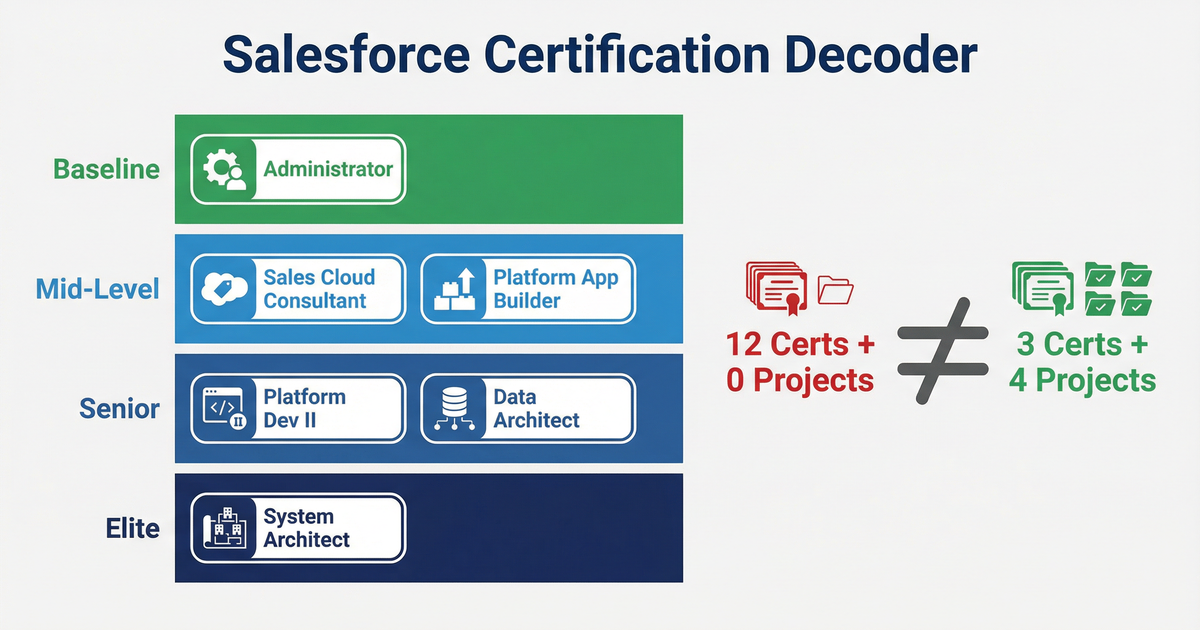
A candidate with 12 Salesforce certifications and zero client implementations is a weaker hire than a candidate with 3 certifications and 4 real projects.
That is not an opinion. That is a pattern I have seen play out over 12 years and hundreds of hires across the ecosystem. Certs prove study habits. Projects prove capability. The Salesforce community has a cert collection culture, and recruiters are the ones paying the price for not knowing the difference.
What Certifications Actually Prove (and What They Do Not)
Every Salesforce certification is a multiple-choice exam. 60 questions. 90-105 minutes. Passing score around 65-73% depending on the exam. There is no practical component. No code review. No client simulation. No demonstration of work.
This means a certification proves: the candidate studied the material, understands the concepts, and can pass a multiple-choice test under time pressure.
It does not prove: the candidate can implement those concepts in a real org, troubleshoot production issues, manage stakeholders, or deliver a project.
The Administrator exam tests platform navigation, user setup, security basics, reports, and data management. It does not test complex Flows, real troubleshooting, or stakeholder communication.
Platform Developer I tests Apex syntax, triggers, SOQL, and test classes. It does not test system design, code architecture, or debugging under pressure.
Sales Cloud Consultant tests sales process mapping, Opportunity configuration, and forecasting concepts. It does not test leading discovery sessions, managing client expectations, or handling scope changes.
Data Architect tests data modeling patterns, large data volumes, and migration strategies. It does not test making trade-off decisions in live implementations with conflicting stakeholders.
Which Certs Matter for Which Roles
Hiring an Admin: Expected: Administrator. Bonus: Advanced Admin, Platform App Builder. Red flag: Only Developer certs with no Admin cert. Wrong track.
Hiring a Consultant: Expected: Cloud-specific Consultant cert (Sales Cloud Consultant for Sales Cloud work). Bonus: Admin cert alongside the Consultant cert. Red flag: Only Admin cert with no consulting experience. Passing the Consultant exam without implementations is common.
Hiring a Developer: Expected: Platform Developer I. Strong signal: Platform Developer II (hard exam, relatively rare). Red flag: Multiple admin and consultant certs but no developer cert. May be pivoting into development without the coding foundation.
Hiring an Architect: Expected: Data Architect or Application Architect (or both). Premium: System Architect (requires passing multiple sub-exams). Red flag: Claims architect title with only Admin and Consultant certs. Architecture certifications are the hardest in the ecosystem for a reason.
The Certification Tier List
| Certification | Difficulty | Market Value |
|---|---|---|
| Administrator | Moderate | Baseline (expected for admin roles) |
| Advanced Admin | Hard | Good (shows commitment to depth) |
| Platform App Builder | Moderate | Practical (most versatile single cert) |
| Platform Dev I | Hard | Strong (proves coding ability) |
| Platform Dev II | Very Hard | High (rare, genuinely impressive) |
| Sales/Service Cloud Consultant | Moderate | Good (common requirement, match to Cloud) |
| Marketing Cloud Admin | Moderate | Niche (MC-specific, separate ecosystem) |
| Data Architect | Very Hard | Very High (rare, high credibility) |
| Sharing & Visibility Architect | Very Hard | Very High (security architecture expertise) |
| Application Architect | Very Hard | Premium (requires passing 2 sub-exams) |
| System Architect | Extremely Hard | Premium (elite, requires multiple sub-exams) |
| Agentforce Specialist | Moderate | New (early adopter signal, limited market data) |
Reading a Trailhead Profile
Trailhead (trailhead.salesforce.com) is Salesforce's free learning platform. Candidates have public profiles showing badges, points, and Superbadges.
Badges: Self-paced learning modules. Good signal for junior candidates showing initiative. Not meaningful for senior roles.
Superbadges: Hands-on challenges requiring real configuration. Stronger signal than regular badges. A developer candidate with the Apex Specialist Superbadge has done real work.
Points/Ranger status: Gamification. High points mean time spent on the platform, not job readiness. Do not equate Ranger status with qualification.
How to Tell If Someone Is Lying About Certifications
"Can you show me your certification verification?" Real: Shares their Trailhead profile or pulls up trailhead.salesforce.com/credentials/verification immediately. All Salesforce certs are publicly verifiable by name and email. Takes 30 seconds. Fabricated: Hesitates. Says "I will send it later." There is no legitimate reason a credential holder cannot verify in real time.
"Your [cert] is from 2021. Have you maintained it?" Real: Explains that Salesforce certs require annual maintenance (completing Trailhead modules for each release cycle). Confirms current status, or honestly says it lapsed. Fabricated: Does not know certifications require maintenance. Claiming an active cert that has expired is a verifiable lie.
"Walk me through one concept from the exam that surprised you." Real: Describes a specific question area or topic that was challenging. The specificity of the memory indicates they sat the exam. Fabricated: Cannot recall any content. "It was comprehensive." Someone who sat a 60-question exam remembers at least one topic that gave them trouble.
The One Cert That Tells You the Most
Platform App Builder. It sits between admin and developer. A candidate who holds it understands both configuration and light customization. It covers data modeling, security, business logic, and user interface design in one exam. If a candidate holds only one cert beyond Administrator, this is the one I want to see.
Part 9 of a 10-part series. Previously: Admin vs. Consultant vs. Architect. Next: Job Description Templates
Jeremy Carmona is a 13x Salesforce certified architect, founder of Clear Concise Consulting, and adjunct instructor at NYU Tandon School of Engineering.