

How to Know If Your Candidate Actually Knows Marketing Cloud
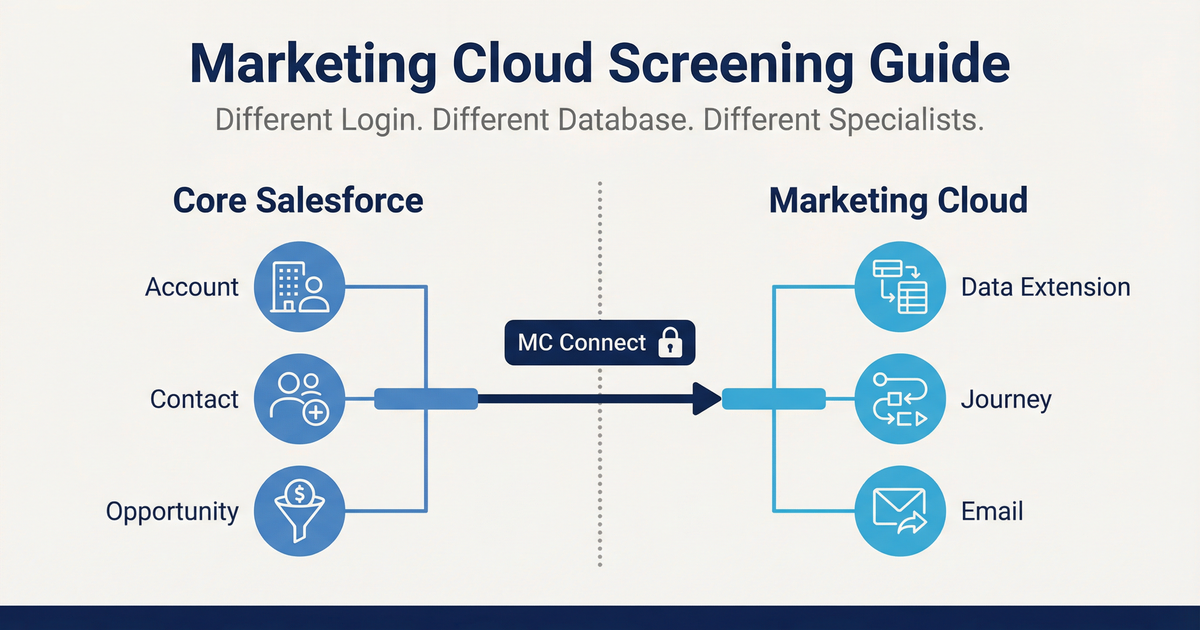
A friendly reminder that will save you from getting ghosted by every Marketing Cloud professional in your pipeline: Marketing Cloud is a completely separate platform from Salesforce.
Different login. Different database. Different interface. Different specialists.
Putting "Salesforce Admin with Marketing Cloud experience" in a JD is like requiring your plumber to also rewire the electrical panel. Technically they both work in your building. That is where the similarities end.
Marketing Cloud manages email marketing, customer workflows, advertising, mobile messaging, and automation at enterprise scale. It has its own certifications, its own data model (Data Extensions, not standard Salesforce objects), and its own scripting language (AMPscript, not Apex).
Core Components (Not "Objects")
Marketing Cloud doesn't use standard Salesforce objects. It has its own data structures:
Data Extension: Data tables (the MC equivalent of Salesforce objects). Key details: primary keys, field types, sendable flag, retention policy.
Journey: Multi-step automated customer workflows in Journey Builder. Entry source, decision splits, wait steps, goals, exit criteria.
Email (Content Builder): Email templates with dynamic content, AMPscript personalization.
Automation: Backend processes in Automation Studio: SQL queries, file imports/exports, data extracts.
Subscriber: Individual contact record in MC. The Subscriber Key is the unique identifier, and mismatched keys are the single most common MC data problem.
Sender Profile: From name and email configuration. Commercial vs. transactional classification.
Experience Tiers
Beginner specialist: Build emails in Content Builder. Create Data Extensions. Set up basic sends. Monitor tracking.
Intermediate specialist: Multi-step Journeys with decision splits. A/B testing. Subscriber preferences. Triggered sends.
Advanced specialist: Cross-channel workflows (email + SMS + push). MC Connect configuration with core Salesforce. Deliverability strategy. IP warming.
Beginner developer: Basic AMPscript (IF/THEN, Lookup). Simple SQL in Automation Studio.
Intermediate developer: Complex AMPscript with nested lookups. Automation Studio workflows with SQL and file drops. SSJS for landing pages.
Advanced developer: Custom API integrations. WSProxy for server-side operations. Data architecture across business units.
Five Screening Questions
1. "What is the difference between a Data Extension and a List?" Strong: DEs are modern, flexible storage; Lists are legacy. Knows when each is appropriate. Red flag: Has never worked with Data Extensions. Fundamental MC knowledge.
2. "Walk me through a Journey you built." Strong: Entry source, decision splits, wait steps, outputs, testing, goals. Red flag: Cannot explain entry sources or decision split mechanics.
3. "Have you written AMPscript?" Strong: Personalization blocks, conditional content, DE lookups. Can explain syntax. Red flag: Claims developer-level MC experience with no scripting knowledge.
4. "How do you handle deliverability issues?" Strong: SPF, DKIM, DMARC, sender reputation, list hygiene, bounce management. Red flag: Does not know what SPF or DKIM are. Deliverability is core MC work.
5. "How does Marketing Cloud connect to core Salesforce?" Strong: Describes MC Connect, synchronized data sources, separate data models. Red flag: Does not know MC and core Salesforce are separate platforms with separate databases. This is the most important architectural fact about Marketing Cloud.
How to Tell If Someone Is Lying
"What is a Subscriber Key and why does it matter?" Real: Explains it is the unique identifier. Describes how mismatched keys cause duplicate sends, broken workflows, and data integrity issues. Everyone who has used MC in production has dealt with Subscriber Key problems. It is unavoidable. Fabricated: "It is like an email address." Not the same thing.
"Open rates dropped from 25% to 8% in one month. Walk me through your diagnosis." Real: Checks authentication (SPF/DKIM), bounce rates, send frequency changes, IP reputation, Apple Mail Privacy Protection impact. Systematic elimination of variables. Fabricated: "We would change the subject line." That's one possible step, not a diagnostic process.
"What is the difference between a Triggered Send and a Journey Entry Event?" Real: Triggered Sends are API-driven single emails. Journey Entry Events bring contacts into multi-step flows from API, data extension changes, or Salesforce events. Fabricated: Describes all sends as "campaigns."
Job Description Mistakes
If you see: "Salesforce Admin with Marketing Cloud experience" Change to: These are separate roles. Hire a Marketing Cloud Specialist OR a Salesforce Admin.
If you see: "Pardot/Account Engagement" listed interchangeably with Marketing Cloud Change to: Pardot (now Account Engagement) is B2B. Marketing Cloud is B2C/enterprise. Different products, different skills.
If you see: "Marketing Cloud experience" without specifying which studio Change to: "Experience with Email Studio and Journey Builder required. Automation Studio preferred."
Part 4 of a 10-part series. Previously: Service Cloud Screening Guide. Next: Experience Cloud Screening Guide
Free Download: Marketing Cloud Screening Guide
Jeremy Carmona is a 13x Salesforce certified architect, founder of Clear Concise Consulting, and Former Salesforce instructor at NYU Tandon School of Engineering.