

How to Know If Your Candidate Actually Knows Sales Cloud
By Jeremy Carmona | Clear Concise Consulting
A job description crossed my desk last week: "Sales Cloud, Service Cloud, Marketing Cloud, Data Cloud, and CPQ experience required."
That is five specializations in one bullet point. You are not hiring one person. You are assembling an Avengers team but paying a single salary.
Sales Cloud is Salesforce's core CRM product. It manages the entire sales process: leads from first contact through closed deal, accounts, contacts, forecasting, and pipeline reporting. If a company "uses Salesforce" without further context, they almost certainly mean Sales Cloud. This is where the majority of placement volume lives.
The Objects Your Candidate Should Know
Sales Cloud runs on a specific set of database objects. A candidate should be able to name these without hesitation:
Lead: Unqualified prospects before conversion. Key fields: Lead Source, Status, Rating, Company.
Account: Companies or organizations. Key fields: Industry, Type, Annual Revenue, Parent Account.
Contact: Individual people linked to Accounts. Key fields: Title, Department, Reports To.
Opportunity: Active deals in the pipeline. Key fields: Stage, Close Date, Amount, Probability, Forecast Category. This is the most important object in Sales Cloud.
Quote: Formal pricing documents.
Product/PricebookEntry: What the company sells and at what price.
Campaign: Marketing initiatives tracked against pipeline.
Task/Event: Activities tied to records.
If a candidate hesitates when you ask what object tracks deals, that tells you something.
What Each Experience Level Handles
Beginner admin: Creates reports and dashboards. Manages users and permission sets. Imports data. Customizes page layouts.
Intermediate admin: Builds Flows for opportunity automation (auto-tasks when deals hit certain stages, stale deal alerts). Configures lead assignment rules. Sets up duplicate management. Creates custom report types.
Advanced admin: Builds complex Flows with subflows and error handling. Configures Collaborative Forecasting. Sets up territory management. Implements CPQ. Troubleshoots governor limits.
Beginner consultant: Documents requirements. Shadows discovery calls. Creates user stories.
Intermediate consultant: Leads discovery independently. Maps client sales processes to Opportunity stages. Writes functional specifications.
Advanced consultant: Designs multi-object data models. Leads full Sales Cloud implementations end-to-end. Builds executive reporting strategies.
Match the JD complexity to the right tier. If the job requires territory management and CPQ configuration, you need an advanced admin or consultant, not a junior who can build reports.
Five Screening Questions
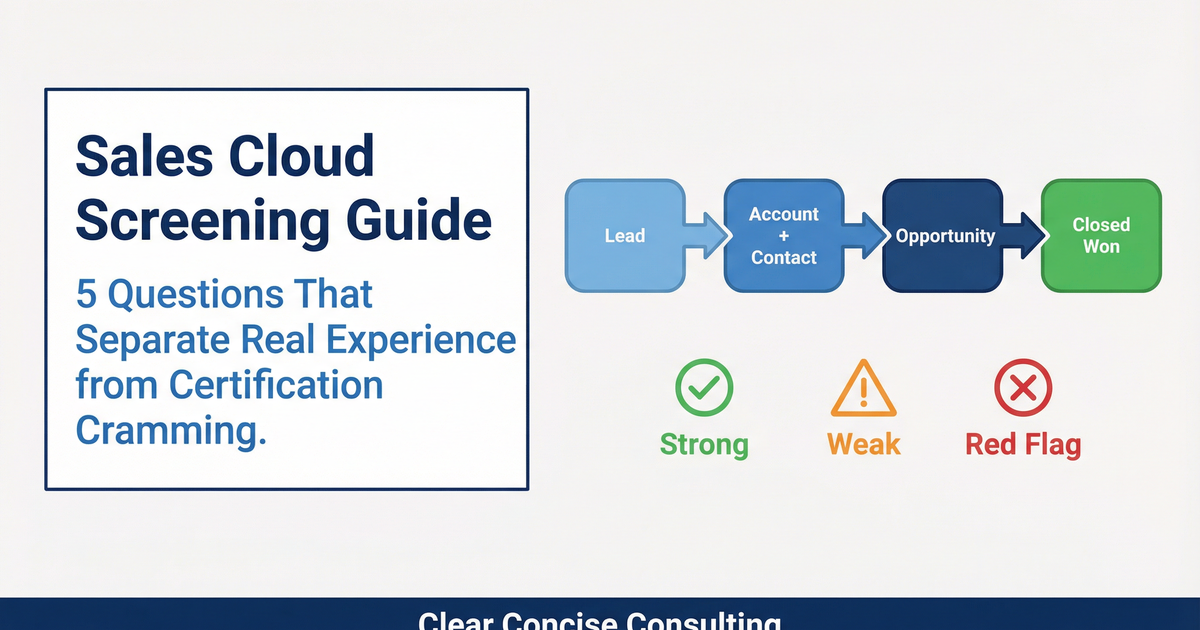
1. "Walk me through how a Lead becomes a customer." Strong: Describes conversion creating an Account, Contact, and Opportunity. Mentions criteria. Red flag: Confuses Leads with Contacts, or doesn't know conversion creates three records.
2. "How did you set up Opportunity stages?" Strong: Maps stages to the client's sales process. Sets probability percentages. Configures path guidance. Red flag: Cannot name the standard stages (Prospecting, Qualification, Needs Analysis, Proposal, Negotiation, Closed Won/Lost).
3. "How do you build a pipeline report leadership trusts?" Strong: Mentions report types, filters, grouping by owner or territory, dashboard components. Red flag: Cannot explain the difference between a report and a dashboard.
4. "Have you worked with territory management?" Strong: Describes territory hierarchies and how they affect opportunity ownership. Red flag: Claims experience but cannot describe a specific implementation.
5. "What automations have you built for the sales process?" Strong: Describes specific Flows with triggers, actions, and testing. Red flag: Only mentions Process Builder or Workflow Rules. Those tools are deprecated. Current professionals build in Flow.
How to Tell If Someone Is Lying
"Tell me about a time an Opportunity automation broke in production." Real experience sounds like: "The record-triggered Flow was firing on every save, not just stage changes. It created 47 duplicate tasks before we caught it. I checked the debug logs, found the entry criteria was missing a condition, and fixed it in sandbox before deploying." Fabricated experience sounds like: "I fixed some bugs." No objects. No root cause. No debugging process.
"What is the difference between a Closed Won opportunity and a Converted Lead?" If they conflate these two events, they haven't worked in Sales Cloud for more than a month. Lead conversion and opportunity closure are different stages of completely different processes.
"Your client's forecast numbers don't match the pipeline report. Where do you start?" Real answer involves forecast categories vs. stages, report filter discrepancies, and owner inclusion. Generic answer: "I would check the report filters." That's not a diagnosis. That's a guess.
Job Description Mistakes
If you see: "5+ years of Sales Cloud AND Service Cloud AND Marketing Cloud" Change to: Specify which Cloud is primary. Most candidates specialize in one or two.
If you see: "Must know Apex" on an admin role Change to: "Must be proficient in Flow automation and reporting."
If you see: "Salesforce experience required" with no Cloud named Change to: "Sales Cloud experience required, including Opportunity management and pipeline reporting."
This is part 2 of a 10-part series. Previously: Salesforce Recruiter Cheat Sheet. Next: Service Cloud Screening Guide
Free Download: Sales Cloud Screening Guide
Jeremy Carmona is a 13x Salesforce certified architect, founder of Clear Concise Consulting, and former Salesforce instructor at NYU Tandon School of Engineering.