
Salesforce Recruiter Cheat Sheet: The Ecosystem in Plain English
By Jeremy Carmona | Clear Concise Consulting
A recruiter messaged me last month asking if I was open to a "Salesforce role." No Cloud specified. No role tier. No indication of whether they needed someone to reset passwords or redesign a data architecture.
That is like calling a hospital and asking for "a medical person."
Salesforce is not one product, one skill, or one job title. It is a platform with 7+ products, 4 distinct role tiers, and a vocabulary that sounds like it was designed to confuse outsiders. This cheat sheet translates all of it into plain English.
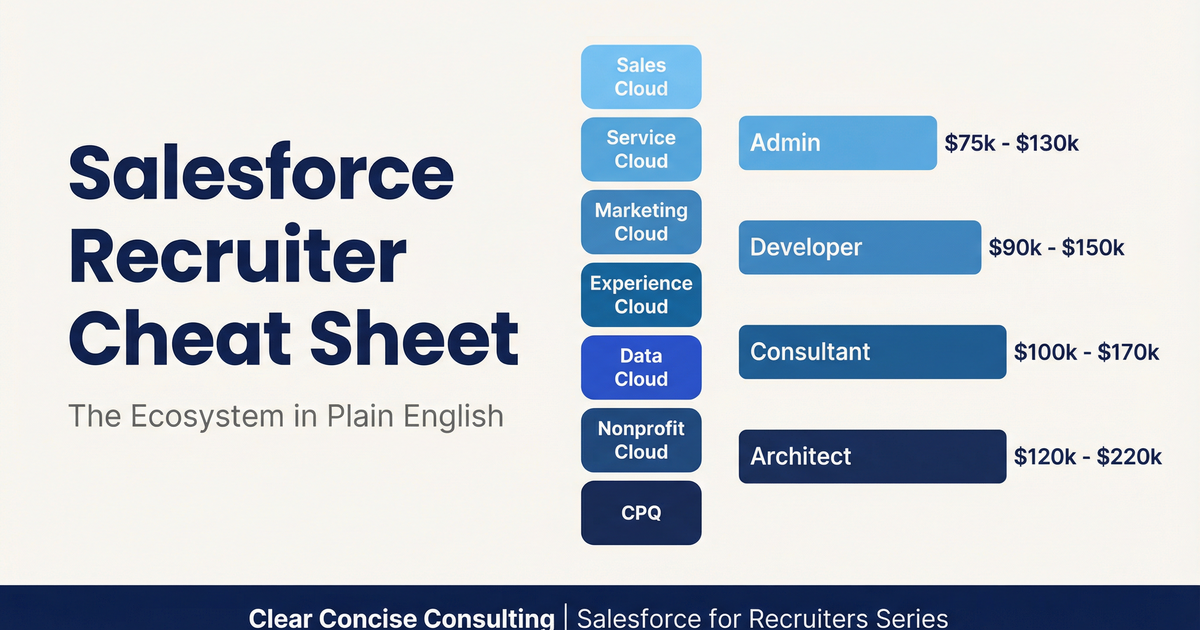
The Clouds: Salesforce's Product Line
Every Salesforce implementation runs on one or more "Clouds." Each Cloud serves a different business function and requires different specialists.
Sales Cloud manages the sales pipeline: leads, deals, accounts, forecasts. This is the most common product. If a company "uses Salesforce," they almost certainly use Sales Cloud.
Service Cloud manages customer support: cases (support tickets), agent routing, SLA tracking. If the company has a help desk on Salesforce, this is it.
Marketing Cloud handles email campaigns, automation, and cross-channel messaging. This is practically a separate platform with its own login, its own data model, and its own specialist market. A Salesforce Admin does not know Marketing Cloud. Full stop.
Experience Cloud builds customer and partner portals on top of Salesforce data. Not web development. Salesforce configuration with a portal interface.
Data Cloud connects external data sources for AI and analytics. The newest major product. Candidates with real experience are rare.
Nonprofit Cloud / NPSP covers donor management, grants, and fundraising. NPSP is the original package. Nonprofit Cloud is the newer replacement. They are different products.
CPQ (Configure, Price, Quote) handles complex pricing and quoting. Specialists are scarce and expensive.
When a job description says "Salesforce experience required," your first question: which Cloud?
The Role Ladder
Admin ($70K-$110K): Configures the platform using clicks, not code. Reports, Flows, user management. Entry to mid-level.
Developer ($100K-$150K): Writes custom code. Apex, Lightning Web Components, API integrations. Mid to senior.
Consultant ($100K-$140K): Gathers requirements, designs solutions, manages implementations. Sits between business and technical teams.
Architect ($140K-$200K+): Designs technical strategy across entire environments. Data models, integrations, security, governance.
An admin with 8 years of experience is not an architect who hasn't been promoted. These are different jobs requiring different skills.
Objects Every Candidate Should Know
These are the standard database tables in every Salesforce org. If a candidate cannot name at least five, they are not ready:
Account (companies), Contact (people), Opportunity (deals), Case (support tickets), Lead (unqualified prospects), Task/Event (activities), Campaign (marketing initiatives), Report/Dashboard (analytics), User (system logins), Permission Set (access controls).
Five Terms You're Getting Wrong
"Apex required" on an admin role. Apex is code. Admins do not code.
"CPQ" listed casually. Verify the company actually uses it. CPQ talent is scarce.
"Lightning experience." That's the current UI. Not a skill. Like requiring "experience with Chrome."
"Integration experience." Integration with what? MuleSoft and a Mailchimp plugin are not the same.
"Nonprofit experience" without specifying NPSP or Nonprofit Cloud. Different products.
Three Questions That Expose Fake Experience
"What is the difference between a Profile and a Permission Set?" If they can't explain one-per-user baselines (Profile) vs. additive access (Permission Set), they haven't configured security in a real org.
"Tell me about a time you broke something in production." Every Salesforce professional has a war story. The absence of one is the red flag.
"What is a sandbox and how do you use it?" If they can't describe sandbox types and the deployment workflow, they've only used Trailhead.
What Experience Levels Look Like
Beginner (0-2 years): Can build reports, manage users, create simple Flows, import data. Cannot design data models or lead implementations.
Intermediate (2-5 years): Can build multi-step Flows, configure approval processes, manage sandbox deployments. Cannot architect integrations or lead multi-cloud projects.
Advanced (5+ years): Can design data architecture, build complex integrations, lead full implementations. These are your consultants and architects.
How to Read Certifications
Certs prove exam passing, not job readiness. A candidate with 3 certs and 4 years of client work is stronger than 12 certs with zero implementations. Every time.
The most telling cert: Platform App Builder. It sits between admin and developer and shows practical range.
Download the Salesforce Recruiter Cheat Sheet
This is part 1 of a 10-part series. Next: Sales Cloud Screening Guide
Jeremy Carmona is a 13x Salesforce certified architect, founder of Clear Concise Consulting, and former Salesforce instructor at NYU Tandon School of Engineering.